Insights

Longer work, and the world underneath it.

A study sets out a matter at length: what the evidence supports, what it does not, and where the argument would break. Each one carries a hundred adjudicated claims resolving to numbered references, and ships with the model of its own world, so you can move the numbers and watch the conclusion hold or fall.

Showing all 6 studies.

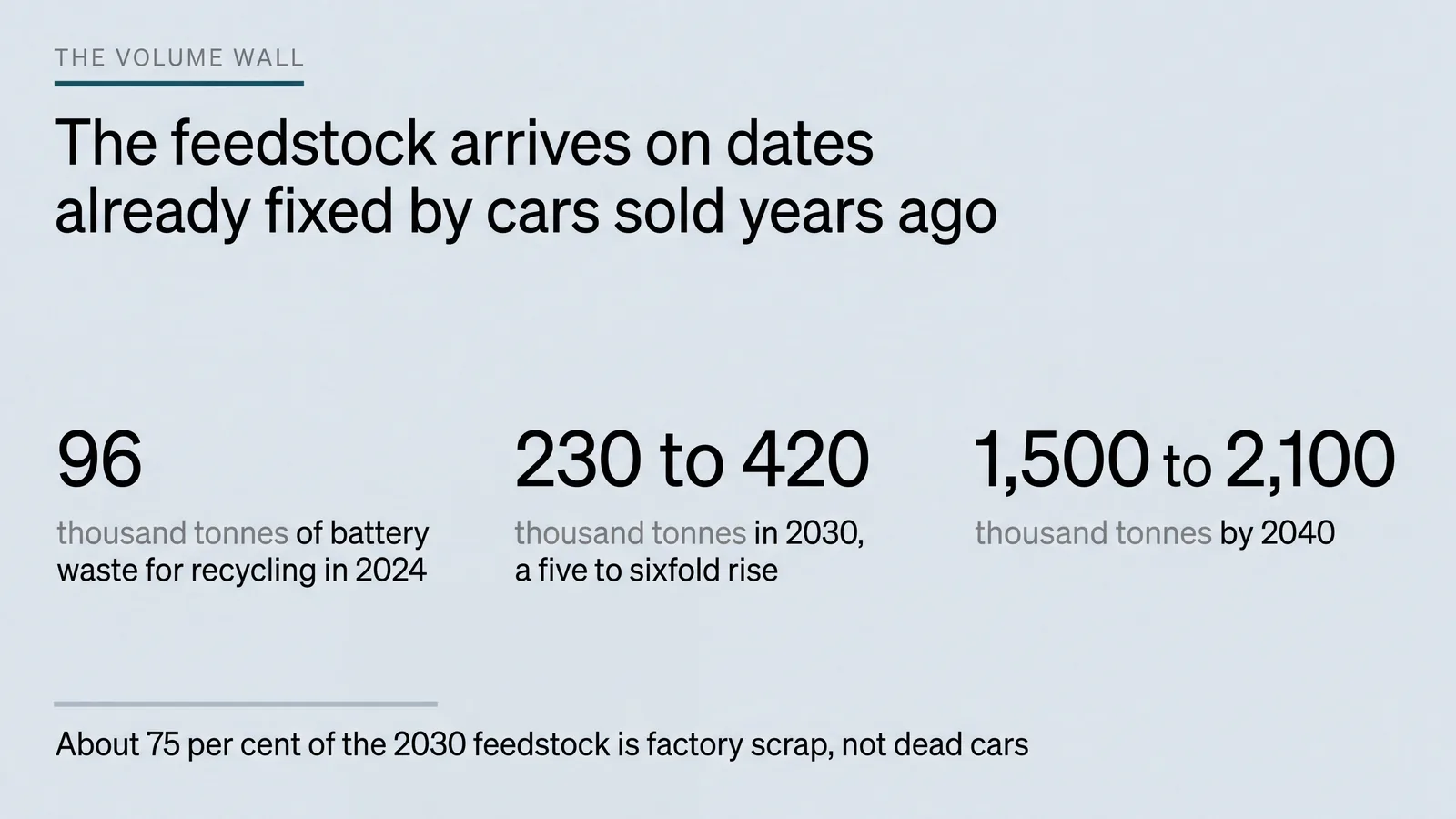
The volume wall: 96 thousand tonnes of battery waste for recycling in 2024, 230 to 420 thousand tonnes in 2030, and 1,500 to 2,100 thousand tonnes by 2040.
Energy and circular economy100 claims · 83 references

Europe’s Most Valuable Mine Is a Scrapheap

Regulation, returning batteries and factory scrap are turning dead batteries into industrial raw material. Who captures the value, and with whose money, is an open race.

Capability demonstratedBankability analysis

Read and download20 pages · 3.5 MB PDF
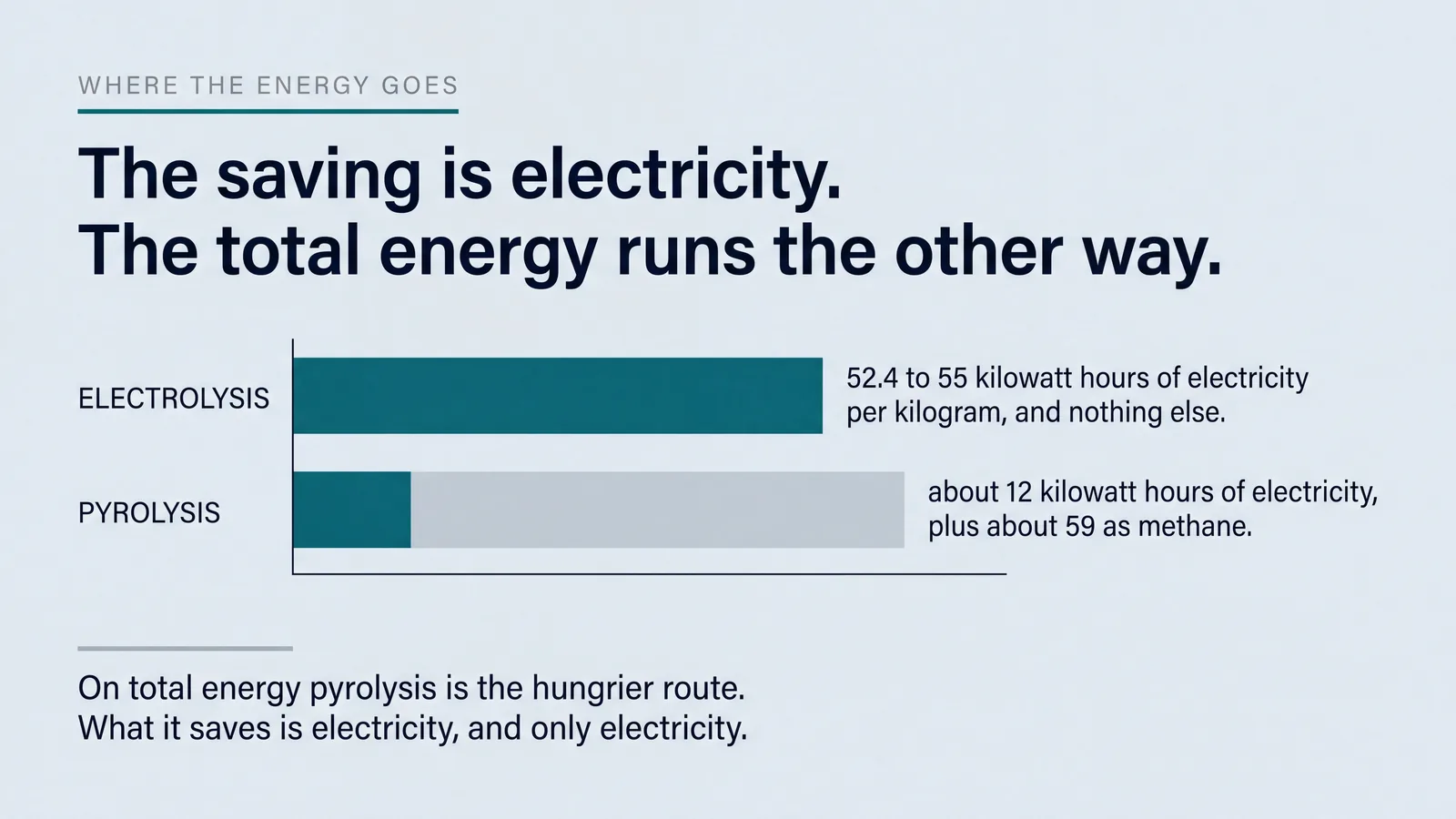
The saving is electricity: 12 kWh per kilogram for pyrolysis against 52.4 to 55 kWh for the two mainstream electrolyser routes.
Energy and deep tech100 claims · 80 references

Hydrogen’s Dark Horse Is Turquoise

Methane pyrolysis makes clean hydrogen and solid carbon instead of CO2, for less than a quarter of the electricity electrolysis needs; two prices and one leak rate decide whether it wins.

Capabilities demonstratedTechno-economic modelling, Patent landscaping

Read and download20 pages · 3.0 MB PDF
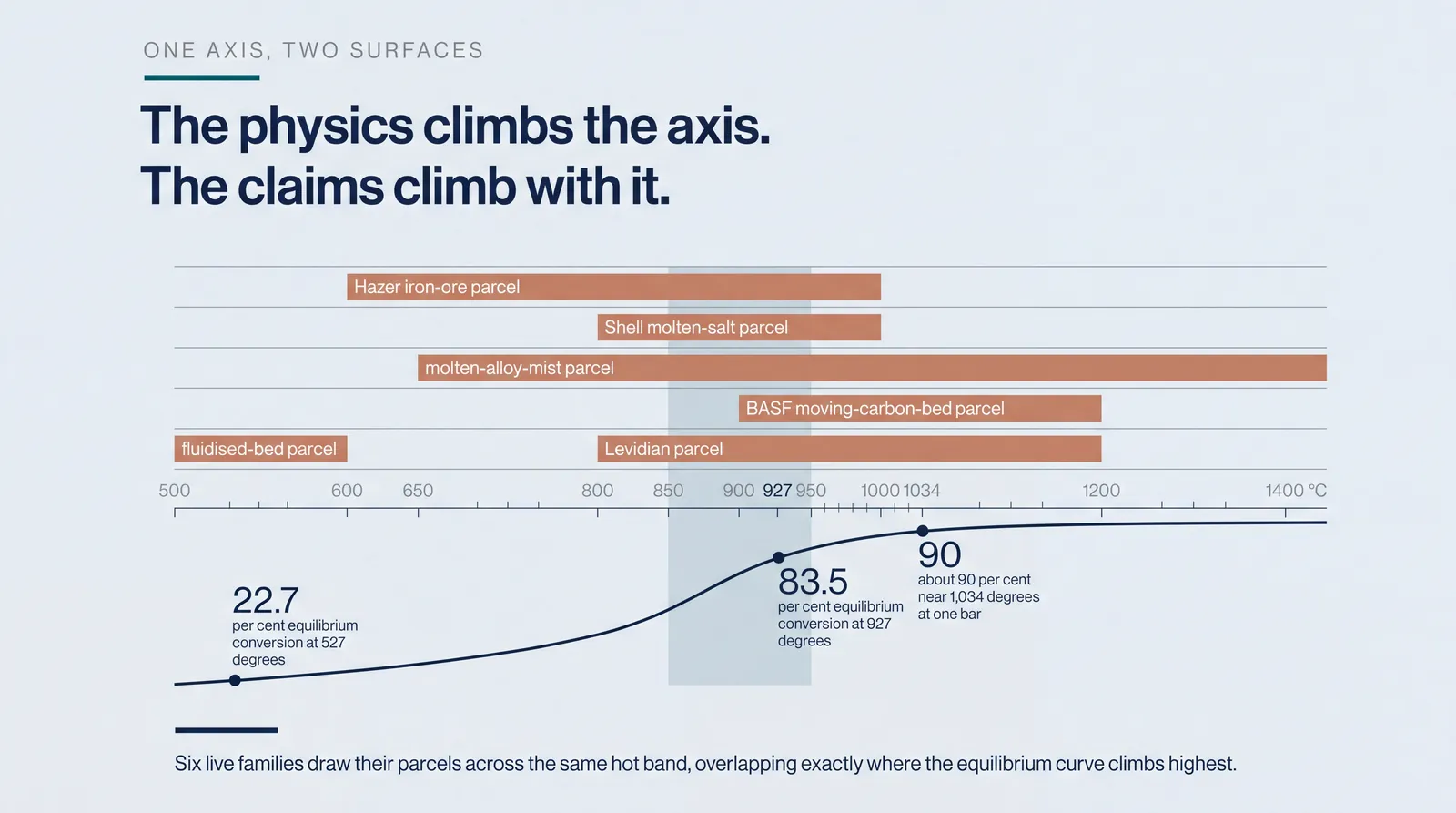
One axis, two surfaces: the equilibrium curve climbs from 22.7 per cent conversion at 527 degrees Celsius to 83.5 at 927 and about 90 near 1,034, while six live claim parcels draw across the same hot band, overlapping where the curve climbs highest.
Energy and deep tech158 claims · 10 references

The Best Temperature Is Taken

A reactor temperature is a process variable and a patent boundary at once. The physics-optimal point on the axis is the most heavily claimed point on it, and every escape route costs conversion, run-hours, or years.

Capability demonstratedProcess-physics modelling and patent claim-boundary landscaping

Read and download14 pages · 1.7 MB PDF
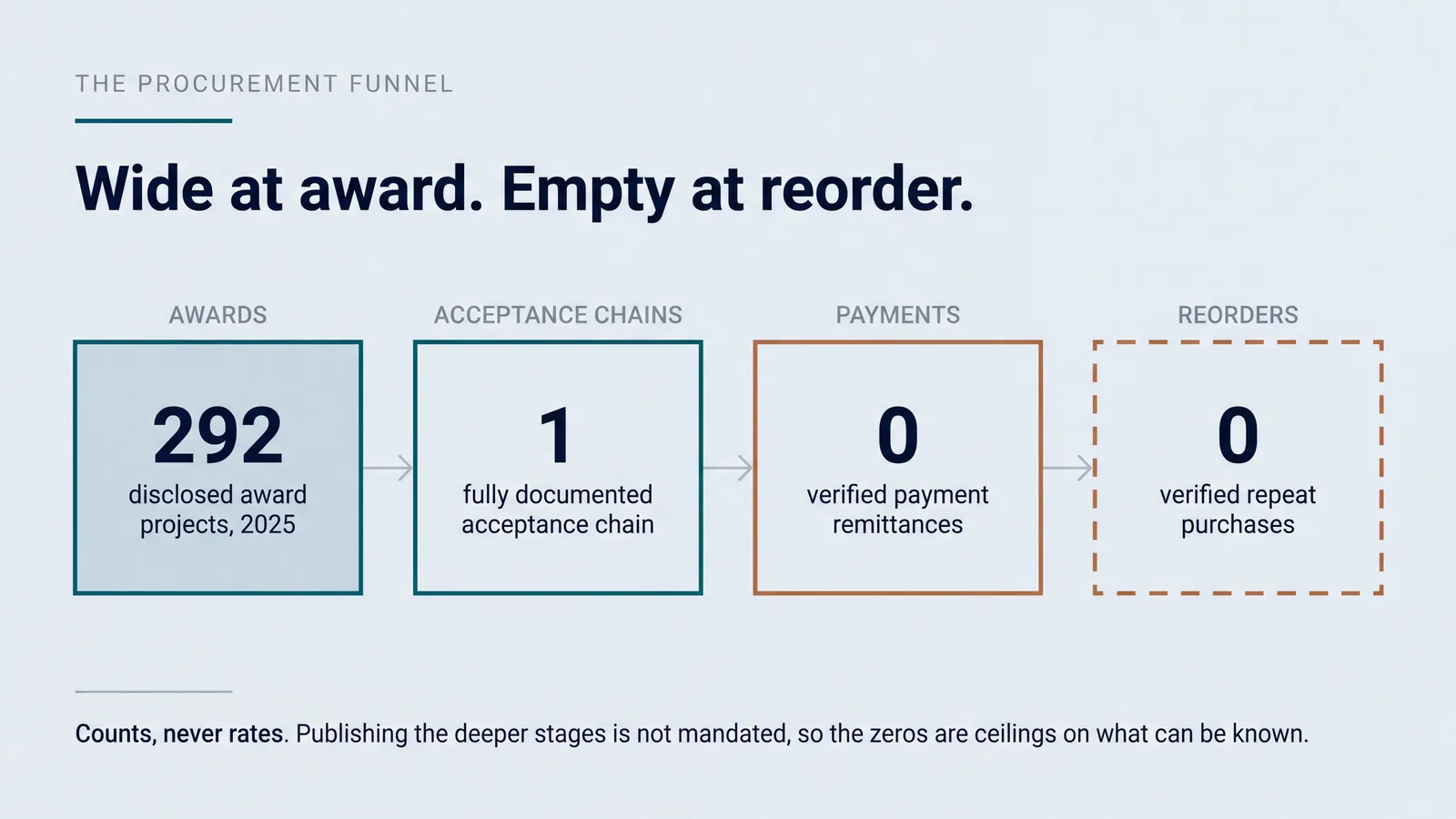
Wide at award, empty at reorder: 292 disclosed award projects, one acceptance chain, zero verified payments, zero verified reorders.
Robotics and AI100 claims · 70 references

The Demo Economy

The West keeps score in demo views and funding rounds. The buyer’s paper trail keeps score in inspections passed, money paid and repeat orders, and that side of the scoreboard is nearly blank.

Capability demonstratedAdjudication and de-biasing

Read and download20 pages · 3.2 MB PDF
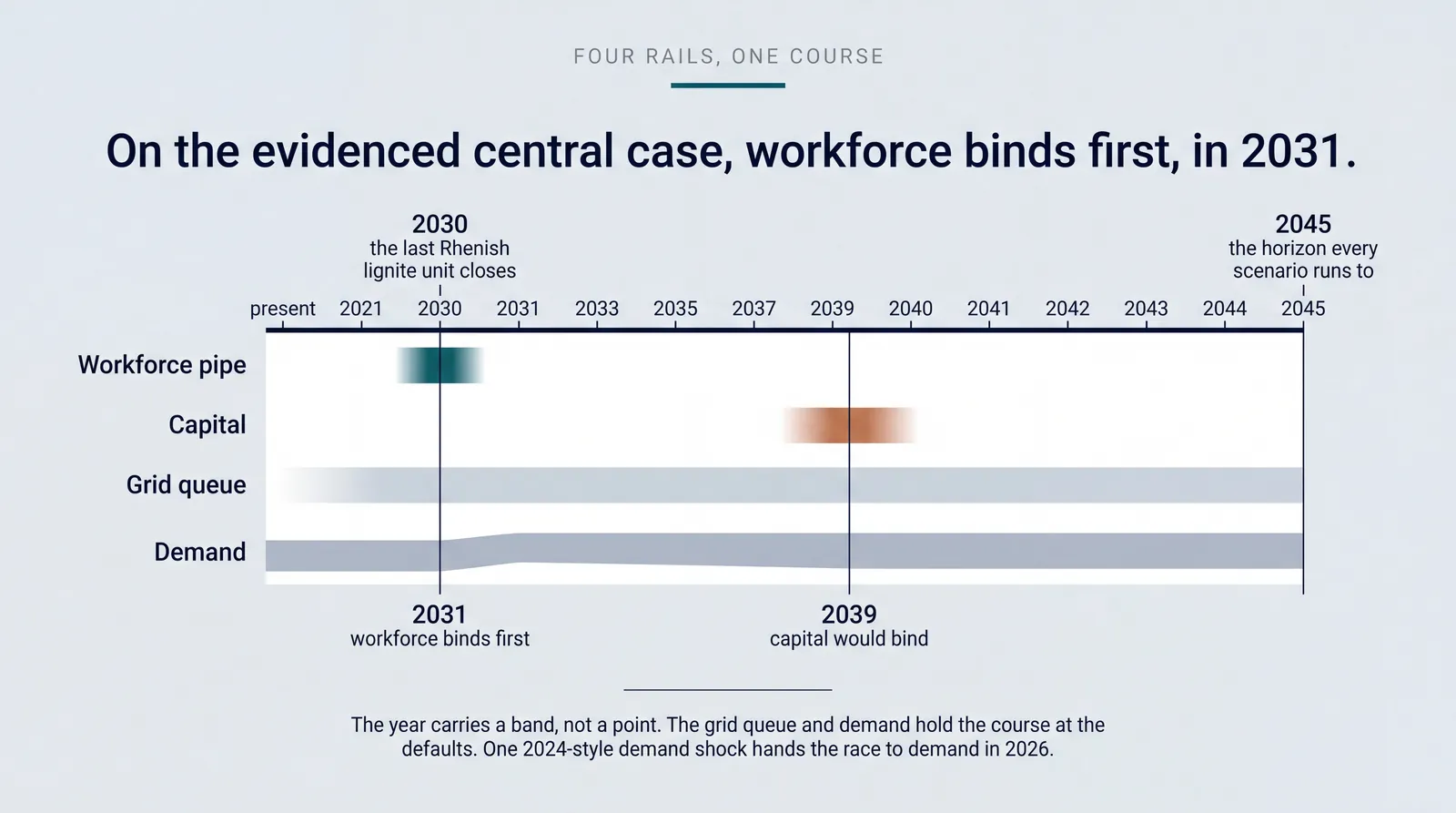
Four rails, one course: on the evidenced central case the workforce pipe binds first in 2031, just after the 2030 coal exit; capital would bind in 2039; the grid queue and demand hold the course to 2045.
Energy and circular economy109 claims · 73 references

The Energy Transition Has a Hiring Problem

North Rhine-Westphalia’s route to climate neutrality is decided in a race between four constraints: people, capital, grid connections and demand. The people constraint is real, but nothing says it binds first. This study puts all four on one course, names the year each could win, and shows what has to be true for the workforce to be the one that matters.

Capability demonstratedBottleneck and interdependency analysis

Read and download20 pages · 3.0 MB PDF
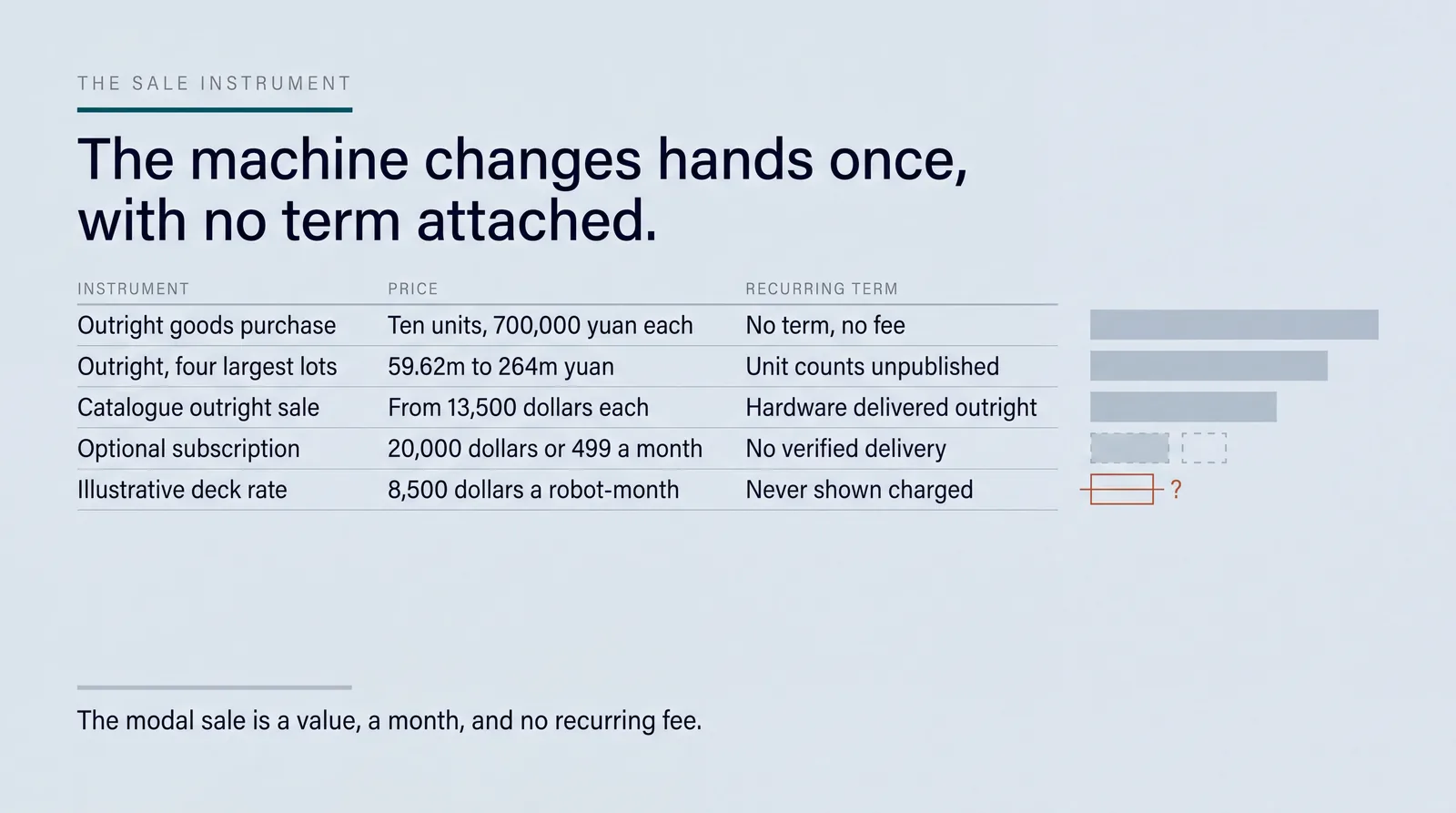
The sale instrument: the machine changes hands once, with no term attached. Outright purchases at 700,000 yuan a unit and catalogue sales from 13,500 dollars, against a subscription of 499 a month with no verified delivery and a deck rate of 8,500 a robot-month never shown charged.
Robotics and AI100 claims · 86 references

The Years After the Sale

The years after a robot is sold are a business of their own. Whether that business pays for itself is decided by how hard the machine is worked and how it is sold, and the audited filings of companies that already run such businesses straddle the line.

Capability demonstratedEvidence collection and adjudication across independent sources

Read and download20 pages · 3.2 MB PDF

Each card states the sector the study is about, and the evidence it stands on: a hundred separately sourced claims, every one of them resolving to a numbered reference with its link verified.

What is behind a study.

A study that cannot be checked is an opinion with typography. These are the conditions every one of them satisfies, and they are the reason the work took as long as it did.

01

Every claim adjudicated

A hundred separately sourced claims per study, each resolving to a numbered reference with its link verified. Every section header states how many claims that section rests on, and every figure carries the claim ids behind the values it prints.

02

A counterweight, argued

The strongest case against the study’s own conclusion is written by someone whose job is to make it, and answered in the text rather than omitted from it. Where it wins, the conclusion moves.

03

What we could not establish

Each study carries a section naming what the evidence did not settle, and a second naming what would change our mind. A gap stated is worth more to a reader than a gap papered over.

04

A world you can argue with

The model under each study ships with it: parameters at their evidenced ranges, the equations that connect them, and the thresholds at which the argument breaks. You can drive it to that point yourself.

Every study also ships the model of its own world: the parameters, the equations, the evidenced ranges and the thresholds at which the argument breaks. The page for each study opens it.

The method is the product, and it is in the open.

These studies demonstrate it on subjects nobody paid us to publish. If the matter you are deciding is not one of them, the same method applies to it, and the first conversation is about whether it should.