Anyone who commissions research knows the position the buyer is in at the end of it. A document arrives, it reads well, and the numbers in it are plausible. What the buyer cannot see is which of those numbers were actually checked. Nor which were repeated from a single source that has been quoted so often it now sounds like consensus. Nor which are simply absent from the record, and have been filled in with a confident sentence. The document does not distinguish between these three cases, therefore the reader cannot either.
Serinyx built Quorum to make that distinction visible. Quorum is our verified-intelligence method. It collects evidence across many models and sources, read cold and without shared context, and it adjudicates the disagreements between them rather than averaging them away. Every figure traces back to a source record, and every link in the reference list is fetched and verified before publication. What Quorum could not establish is recorded as carefully as what it could. The output is a piece of research where the reader can see the state of the evidence behind each claim.
Today we are publishing three studies that demonstrate it, and this note introduces them.
What the showcase is
The Quorum Showcase Series consists of short studies on general industry questions, written to be read in about twenty minutes. Each one carries figures, tables and rendered exhibits, a numbered reference list in which every link was fetched and verified before publication, and a statement of what the study could not determine. Each study is also built on a working model of its subject, in which every input is bounded by the published evidence rather than by what makes a good demonstration. An interactive version of that model accompanies the series, so a reader can change the assumptions and watch the conclusion hold, strain, or fail.
The three opening studies are as follows.
The Demo Economy
This study examines the gap between announced humanoid-robot adoption and the audited record. The public record holds 292 disclosed award projects for 2025. It holds one fully documented acceptance chain, no verified payment remittances, and no verified repeat purchases anywhere. The most-cited Western deployment metrics appear twelve times across the reviewed record and collapse to a single origin, which is the vendor's own pilot dataset. The study is careful about what this does and does not mean. Publishing those deeper stages is not generally mandated for ordinary goods procurement in China, therefore the zeros are ceilings on what can be known rather than statements about what happened. That distinction is the study's central contribution, and it is the kind of distinction that only survives when a method is built to record absence as evidence.
Europe's Most Valuable Mine Is a Scrapheap
This study follows the industrial economics of battery recycling in Europe. Recycling feedstock is expected to reach 230,000 to 420,000 tonnes in 2030 and 1,500,000 to 2,100,000 tonnes by 2040, on dates already fixed by vehicles sold years ago. From August 2031 recycled content becomes mandatory, which means the law rather than the metal price becomes the buyer. Meanwhile the metal that the law made valuable has become cheap, and a seller of black mass keeps only three to five per cent of the lithium price. The refining route decides whether the lithium survives at all, since smelting loses most of it to slag while hydrometallurgy and direct recycling retain almost all of it. Nothing in the regulation requires the recycling to happen in Europe.
Hydrogen's Dark Horse Is Turquoise
This study models methane pyrolysis, which produces clean hydrogen and solid carbon instead of carbon dioxide. It needs roughly 12 kilowatt hours of electricity per kilogram against 52.4 to 55 for electrolysis, although on total energy it is the hungrier route, since it also consumes methane. What it saves is electricity, and only electricity. The economics turn on whether the solid carbon can be sold. A kilogram costs 5.24 euros before any carbon revenue, 2.44 euros with the carbon sold at 700 euros a tonne, and 5.39 euros if the carbon has to be buried. Separately from cost, a methane leak rate above 0.63 per cent invalidates the climate case, and both published figures fail that threshold. A configuration can therefore be the cheapest in the model and still not qualify.
The scale behind each page
Each of these studies is a summary, and the studies say so on their closing page. We think the ratios are the most useful thing in the series.
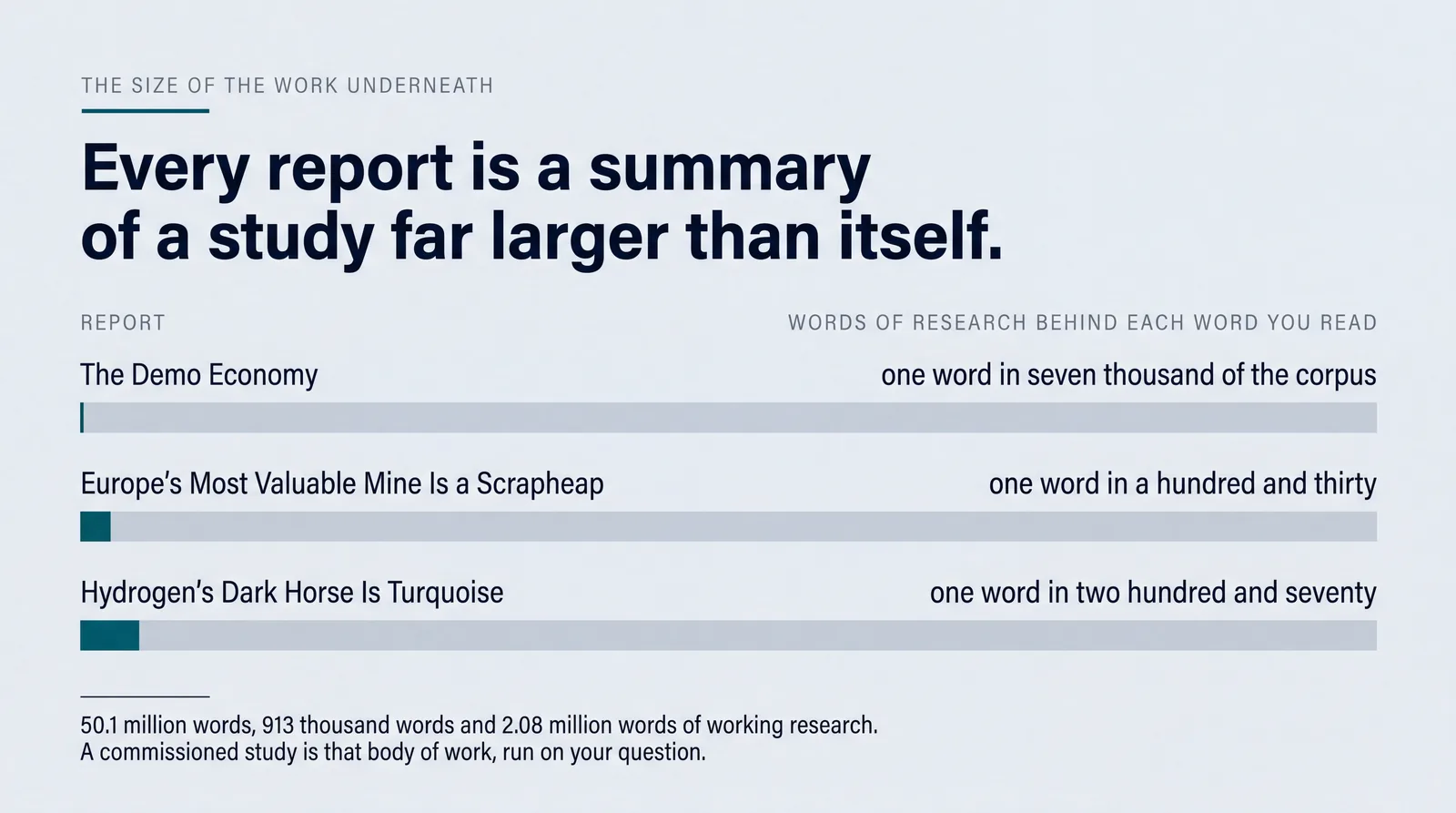
The Demo Economy runs to about 7,000 words. It summarises one part of research whose written chapters alone run to approximately 256,000 words, over a working corpus of about 50.1 million words in 29,111 files. Before a single chapter was written, that research programme asked 263 atomic research questions, collected 3,027 separate model reports against them, and ran 4,250 audits of those reports. What a reader sees is about one word in thirty-six of the finished chapters, and about one word in seven thousand of the corpus.
Europe's Most Valuable Mine Is a Scrapheap summarises one subtopic in a research programme of 12 fields and 72 subtopics. The battery-recycling subtree alone holds approximately 913,000 words across 285 documents and datasets, which makes the published study about one word in a hundred and thirty of the research behind it.
Hydrogen's Dark Horse Is Turquoise draws on approximately 2.08 million words across 1,051 documents and 16 research domains. Those domains run from reactor engineering and the patent landscape through to permitting, funding, and the financial model that produced every cost figure quoted. That is about one word in two hundred and seventy.
What a showcase study deliberately leaves out
We want to be direct about this, since a showcase invites a wrong conclusion. These three studies demonstrate a handful of Quorum's capabilities on topics chosen because they are legible to a general reader in twenty minutes. They are constrained by that choice in ways a commissioned engagement is not.
A showcase study answers a question we selected. It stops at the depth a general audience will follow. It cannot use client data, internal figures, or anything under confidentiality. Sources that cannot be publicly linked are listed without a URL and say so. It compresses a body of research into a fixed length, which means most of the evidence, most of the sub-questions, and nearly all of the working analysis stay behind the summary. The interactive model that accompanies each study exposes a few dozen assumptions where the underlying research carries many more.
None of these are limits of Quorum. They are the shape of a twenty-minute document.
What a commission is instead
A commissioned engagement is not a longer version of one of these studies. It is the research underneath it, run on your question, with your sign-off on the brief and a full audit trail that you can hand to a board or an investment committee.
In practice that means the question is yours rather than ours, and the scope is agreed before any collection begins. It means the corpus is built for that question, at the scale the question needs, which for the research behind these three studies ran from several hundred thousand to tens of millions of words. It means your own data can sit inside the evidence base alongside the public record. It means the review before release is adversarial by design, since somebody is asked to argue against the conclusion using the same evidence. The deliverable is then whatever the decision requires. That might be a board paper, a diligence pack, a regulatory analysis, a pricing model, a patent landscape, an index methodology, or a live model your team keeps using after the engagement ends.
The three studies are free to read, and we would rather be judged on them than on a description of our method. If the questions in front of you look like the questions in these studies, and the answers you are being given do not show their evidence, we would be glad to hear from you.