Hydrogen’s Dark Horse Is Turquoise
Methane pyrolysis makes clean hydrogen and solid carbon instead of CO2, for less than a quarter of the electricity electrolysis needs; two prices and one leak rate decide whether it wins.
A third route to clean hydrogen either undercuts both incumbents in a defined window or it does not, and the window is set by prices a plant does not control.
Published 21 pages
Abstract
There is a third way to make clean hydrogen, and it is not a compromise between the other two. Methane pyrolysis splits natural gas with heat and no oxygen, breaking methane into hydrogen and solid carbon: no CO2 at the point of production, and roughly 12 kWh of electricity per kilogram against the 52.4 to 55 kWh the two mainstream electrolyser routes need. That is an electricity saving rather than an energy saving, since the methane feed carries about 59 kWh per kilogram, so on total energy pyrolysis is the hungrier route. The economics come from an adjudicated European financial model of a first-of-a-kind modular plant on verified February 2026 inputs, and they turn on what the solid carbon by-product is worth.
Key findings
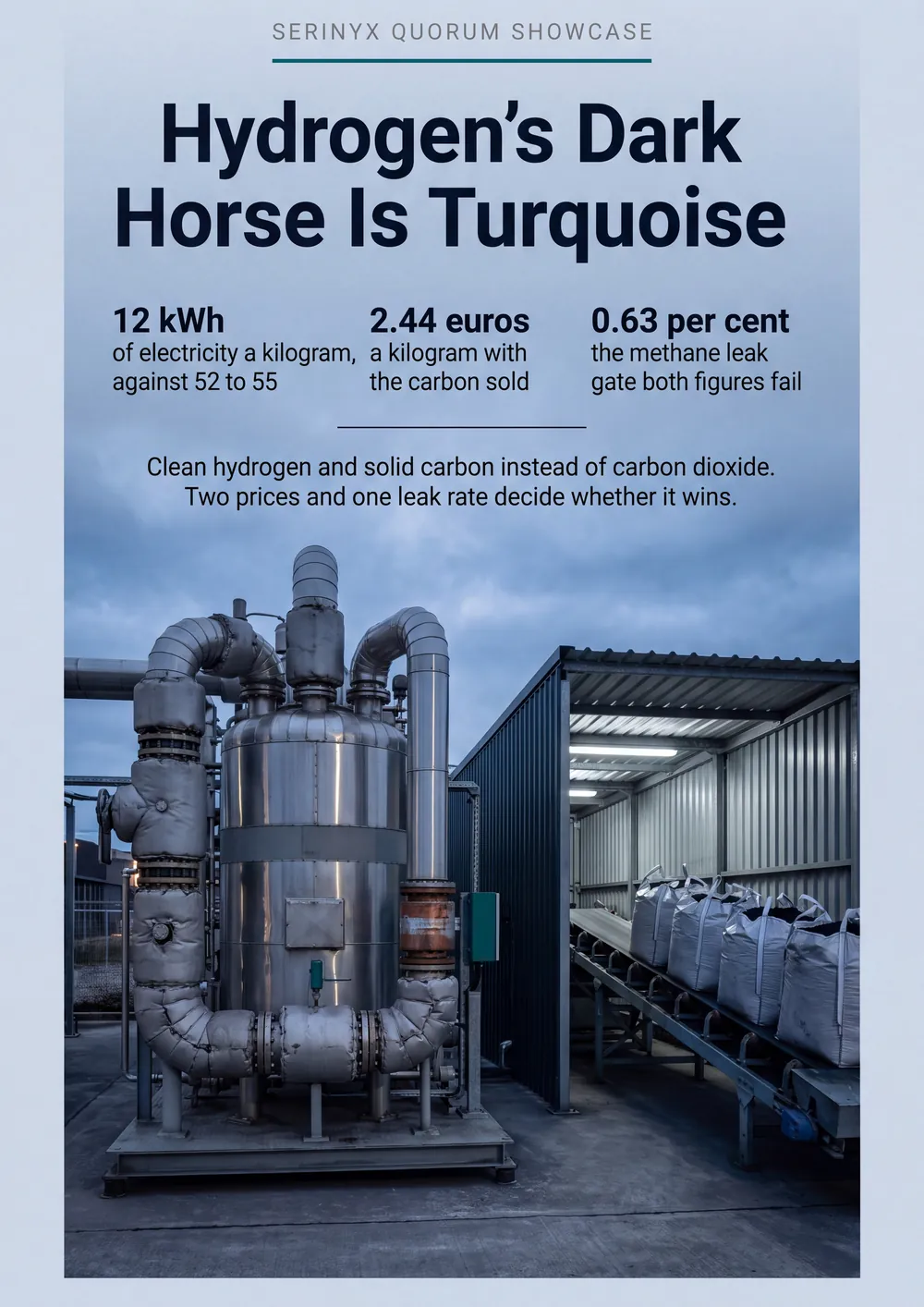
- 12 kWhThe electricity in a kilogram of pyrolysis hydrogen, against 52.4 to 55 for the two mainstream electrolyser routes: about a fifth. Electricity only; the methane feedstock carries most of the plant’s total energy.
- €2.44 / €5.24The modelled cost of a kilogram from a first-of-a-kind modular plant on February 2026 European inputs, with the solid carbon sold at €700 a tonne and with it earning nothing. Paying to bury it costs €5.39.
- €5.20How far the carbon price alone moves the cost of hydrogen across its modelled range, more than every other lever combined. The gas price is second, worth €1.97.
- 0.63%The methane leakage ceiling above which the near-zero climate claim fails on 100-year accounting. The global average of about 0.8 per cent and the literature’s central 1.58 per cent both fail it.
The report rests on 100 separately sourced claims resolving to 80 numbered references, every link verified. Each section header states how many claims it stands on, and every figure carries the claim ids behind the values it prints.
PDF, 21 pages, 3.0 MB. No form, and no mailing list to join, because we do not run one.
Argue with it.
Set the gas price, the electricity price, the carbon price, what the solid carbon sells for and how much methane leaks upstream, and watch the cost of hydrogen and the climate gate move together.
Everything loads at the report’s own case, and one click puts it back. Move anything beyond the published evidence and the affected numbers say so. The model is the one the report was written against, not a demonstration built beside it.
Open the world modelThis report is a very limited showcase of Quorum.
About one word in two hundred and seventy of the research behind it. This report runs to roughly 7,700 words. It is a summary of a study holding approximately 2.08 million words of research across 1,051 documents and 16 domains, from reactor engineering and the patent landscape to permitting, funding and the financial model behind every cost figure it quotes.
Every factual statement in it carries a reference to a verified source, and every figure carries the claim ids behind each value it prints. A commissioned engagement is not a longer version of this document. It is the research underneath it, run on your question, with your sign-off on the brief and an audit trail you can hand to a board.
- Techno-economic modelling
- Every cost figure traces to an adjudicated European levelised-cost model, and the world model linked from this page lets you run that model yourself.
- Patent landscaping
- Every patent count and family in the report traces to a mapped public filing. An earlier cut deferred this capability, because the first harvest held no countable patent facts, and said so rather than filling the gap.