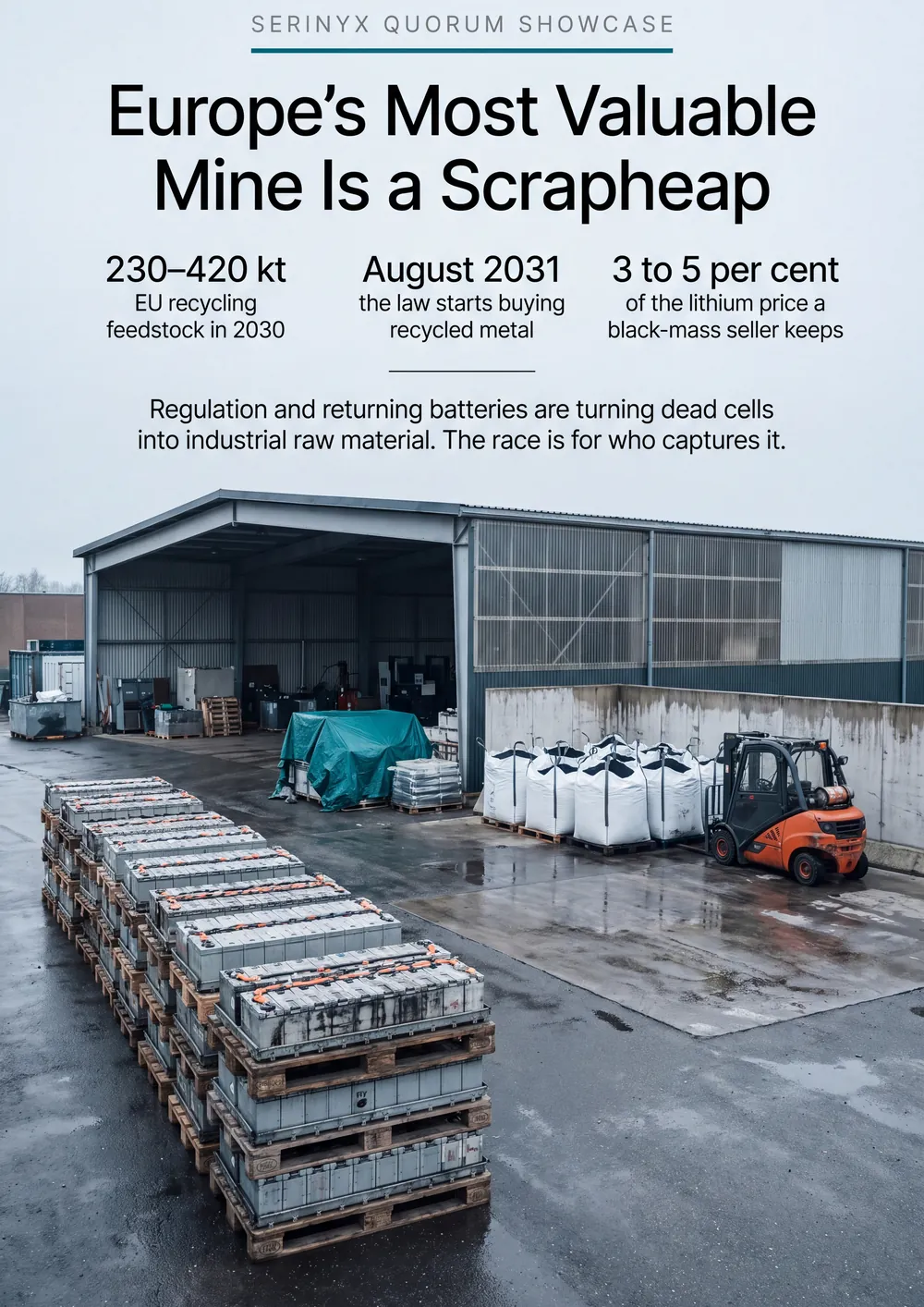
Europe’s Most Valuable Mine Is a Scrapheap
Regulation, returning batteries and factory scrap are turning dead batteries into industrial raw material. Who captures the value, and with whose money, is an open race.
A buildout worth billions is being financed now against volumes that arrive on dates already fixed, under a law that does not require the recycling to happen in Europe.
Published 20 pages
Abstract
Europe is about to inherit a mine it never dug. The yearly flow of battery waste and factory scrap available for recycling was 96,000 tonnes in 2024, and forecasts put it at 230 to 420 thousand tonnes in 2030 and 1,500 to 2,100 thousand tonnes by 2040, a five to sixfold rise inside a decade, on dates set by cars already sold. EU law turns that flow into demand: recyclers must recover half the lithium they process by the end of 2027, and from August 2031 every new EV, industrial and starter battery sold in the EU must contain minimum shares of recycled cobalt, lithium and nickel. One thing the law, as harvested, does not say is that the recycled material must have been recycled in Europe. That silence is the open flank in the whole story.
Key findings
- 230–420 ktEU recycling feedstock in 2030, rising to 1,500 to 2,100 kt by 2040: a five to sixfold rise inside a decade, on dates set by cars already sold.
- August 2031The law starts buying. Every new EV, industrial and starter battery sold in the EU must contain 16 per cent recycled cobalt, 6 per cent lithium and 6 per cent nickel, rising in 2036, whatever metals cost.
- 3–5%The share of the lithium price a seller of black mass keeps. The discount goes to whoever refines, and 89 per cent of that capacity sat in China in 2025.
- 8–10%The yearly return in the corpus’s base project economics: viable with concessional finance, not compelling for private capital alone. Bankability, not volume, decides who is still standing in 2031.
The report rests on 100 separately sourced claims resolving to 83 numbered references, every link verified. Each section header states how many claims it stands on, and every figure carries the claim ids behind the values it prints.
PDF, 20 pages, 3.5 MB. No form, and no mailing list to join, because we do not run one.
Argue with it.
Set the arrival rate, how much reaches a European plant, which refining routes clear their costs, and how much of the powder Europe refines rather than sells.
Everything loads at the report’s own case, and one click puts it back. Move anything beyond the published evidence and the affected numbers say so. The model is the one the report was written against, not a demonstration built beside it.
Open the world modelThis report is a very limited showcase of Quorum.
About one word in a hundred and thirty of the research behind it. This report runs to roughly 7,000 words. It is a summary of one subtopic in a research programme of 12 fields and 72 subtopics, and the battery-recycling subtree alone holds approximately 913,000 words of research across 285 documents and datasets.
Every factual statement in it carries a reference to a verified source, and every figure carries the claim ids behind each value it prints. A commissioned engagement is not a longer version of this document. It is the research underneath it, run on your question, with your sign-off on the brief and an audit trail you can hand to a board.
- Bankability analysis
- One half of the report’s registry capability, bankability and impact metrics. The other half is not demonstrated here, and the report says so. The returns, capital intensity, financing stack, secured share and investment gap restate the corpus’s modelled project economics for a public reader.